CONSULTANCY at SWAN: briefing paper on COVID-19 impact
SWAN recruits a consultant on COVID-19 impact

SWAN recruits a consultant on COVID-19 impact
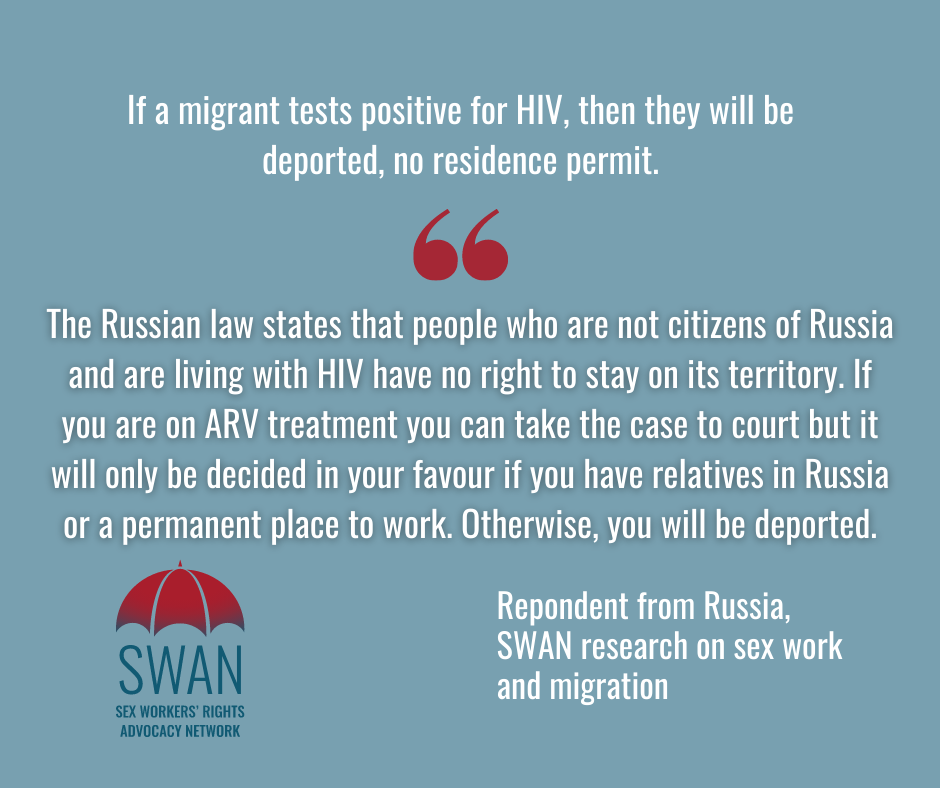
According to estimates, up to 3.5 million irregular migrants were living in the EECA countries at any given moment, representing more than 1 percent of the region’s total population. 2021 theme is Harnessing the potential of human mobility as migrants contribute with their knowledge, networks, and skills to build stronger, more resilient communities. The global social and […]

Since the beginning of the COVID-19 pandemic in Europe and Central Asia, sex workers have reported extreme concerns with the dramatic impact on their living conditions, including the ability to earn a living and access to health. ICRSE and SWAN have published several statements, as well as calls for action and policy demands, to alert authorities and policy makers about the situation. This resource was developed as part of a monitoring exercise to document the impact of COVID-19 pandemic and related measures on sex workers’ access to health services.

COVID-19 continues to spread around the world and its devastating effects are becoming more visible especially within homeless people, drug users, people with disability, undocumented migrants, sex workers and many others. Sex workers have always been in intersection with the most marginalised communities and faced discrimination and violence from police and state actors. Now as this health crisis is expanding, what we are seeing is an immense increase of vulnerability and deterioration of conditions and safety.

Global Network of Sex Work Projects published an interactive map that provides information on laws which criminalise the sale of sexual services, the purchase of sexual services and the facilitation, management or organisation of sex work.
The information in the map reflects legislation (as of 31 December 2018) that exists in relation to sex work, rather than how laws are enforced or the impact they have on sex workers.
Between 18-19th of November, SWAN provided technical assistance to Woman for Freedom in Georgia, for their 2-day advocacy planning meeting with their members. The meeting was organised within the Cities Project and held in the office of Woman for Freedom, in Tbilisi, Georgia.
According to statistics, about 25 thousand people were diagnosed with human immunodeficiency virus in Kazakhstan. But on the eve of the World AIDS Day, let’s not talk about the numbers, because the exact number of people living with HIV cannot be stated by any medical facility. There is an endeavor to try to understand how they live with the diagnosis, which for most of us sounds like a sentence. And what kind of help they can expect.
Recently, Ukrainian and Russian media have once again started discussing sex work related issues in Ukraine due to the fact that the MP from the “Self-Help” party Andrey Nemirovskiy registered a draft law “On regulation prostitution and sex establishments’ activity” (№3139) in the Supreme Council of Ukraine. This law has caused a great resonance in society, and caused a debate on legalization of sex work in Ukraine.
In July and August police busted several premises that were used to provide sex services in Kiev. In one case, the sex workers were arrested and they faced administrative fines, in the other case, the owners are under criminal investigation. At the same time Amnesty International voted for decriminalization of all the aspects of sex work, and shortly after the head of Kiev police Aleksandr Tereshchuk supported the idea of legalization of sex work. Moreover, on August 30 a petition was launched on the e-petition website of the President of Ukraine.